Basic
Thanks to a digital decision-making tool, community health workers in Lesotho can diagnose and treat people with diabetes and hypertension. Some 16,000 adults living in remote regions of Lesotho have been supported as part of the ComBaCaL project. An expansion of the project is in the pipeline.
Content

Content Text
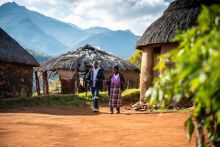
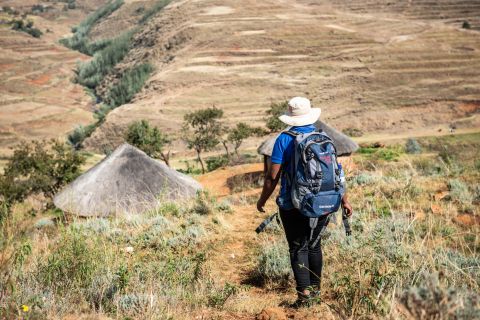
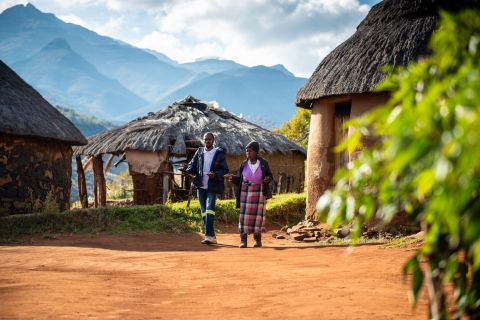
In the quiet hills of rural Lesotho, healthcare is delivered on foot by community health workers. These laypeople have been trained as part of ComBaCaL (Community-Based Chronic Care Lesotho). In the remote village of Shapa-Ngoetsi in Lesotho’s Butha-Buthe district, 39-year-old ‘Makelello Moleko works as a trusted community health worker. From the paved road, a long path winds up through the hills of the village, where the river hums below and dry fields of maize, wheat, and sorghum stretch towards the horizon. This is Moleko’s home village and is where she makes her daily rounds, carrying her ComBaCaL backpack filled with her tools and equipment. Her destination today is the home of ‘Matšoeu Qhophela, a 56-year-old woman who suffers from hypertension.
More than a community health worker
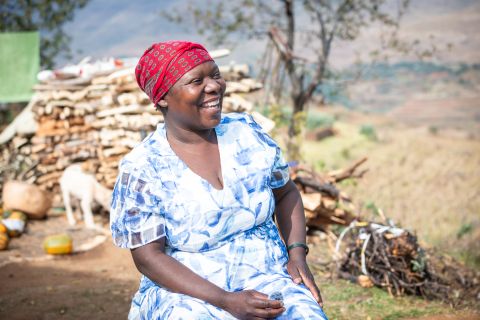
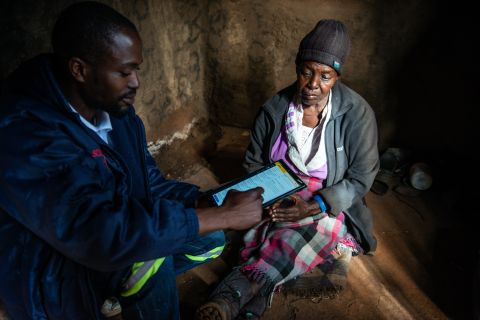
’Matšoeu Qhophela lives in two neat rondavel houses, surrounded by a swept yard. She sits waiting in a floral dress, headscarf, and trainers. She looks radiant, despite the burdens of health and life. Inside her traditional home, the floors are swept, and the walls are simple but decorated with care. Moleko arrives and greets her warmly. They begin their usual routine. Moleko pulls out her tablet, opens the e-health application, and goes through her patient’s health records. “Without the app the work was tedious. And writing by hand wasn’t easy. I much prefer working with the app, as it guides us and reminds us how we need to do things,” she explains.
Content Media
Content Text
The two women talk about family, how Qhophela’s been feeling, and how she’s managing her condition. Moleko gently asks if she is still using snuff. “No”, Qhophela answers with a smile. “I’ve stopped, for the sake of my health.” Moleko nods approvingly. She first checks Qhophela’s blood pressure, then measures her weight using portable scales; each result is recorded in the e-health app. She updates the date of their next appointment in Qhophela’s bukana, her health booklet. Before she leaves, they exchange a few final words, filled with laughter and mutual respect.
For patients like Qhophela, Moleko is more than a community health worker; she is a sister, a neighbour, a lifeline. “We have a close relationship,” Qhophela says. “She is one of us. We chose her to help our village, and she hasn’t disappointed us. She is patient and is growing with the work. We see it, it’s not easy, but she’s doing it. She visits us, even when she’s tired. She’s going the extra mile and is a great help to the community.”
Content Text
Research success for community healthcare
As part of the project, more than 16,000 people in 113 villages have been screened for diabetes and hypertension for the first time by community health workers. Thanks to this new approach, over 98% of adults in remote communities were screened by the end of 2024. To check the effectiveness of the ComBaCaL method, researchers compared two groups of people: around half of people received counselling and were referred to a health facility after their diagnosis. The other half were looked after and treated by community health workers with the aid of the app.
With regard to hypertension, the researchers showed that both groups are now receiving better care than they did before the project –the second group even better than the first. ComBaCaL is the first project in the world to show that trained laypeople can independently prescribe and dispense hypertension and diabetes medications safely and effectively using a dedicated app.
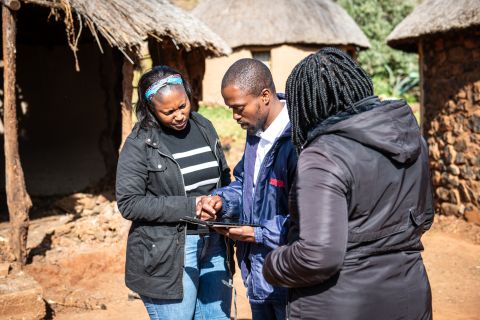
Sesale Masike, the project team’s data and IT officer, explains that the ComBaCaL app is built on an open-source platform that is already used by governments in other countries. “We intentionally chose this platform with the University of Basel because it allows clinical algorithms to be embedded directly into the system. These algorithms trigger specific tasks and reminders for community health workers, helping them manage patient care effectively,” he explains.
Once patients are registered and have been examined for the first time, the app notifies the community health worker, for example when a follow-up visit is due. It might say: “You’re scheduled to see patient A next week”. This ensures that no one slips through the cracks. “After gathering clinical data, it also guides the community health worker through decision-making steps: what to do next, when to refer a patient, and when to escalate care,” explains Sesale Masike. Even in the absence of a supervisor, as long as they enter accurate data, the app provides clear guidance on the next steps.
Zitat
Content Text
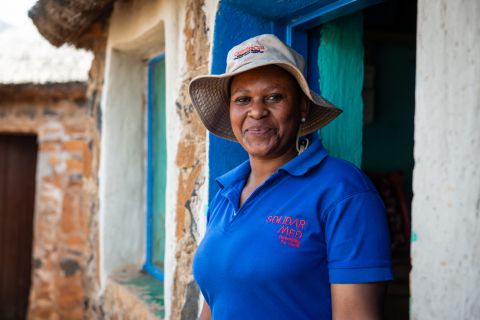
’Mamorontšane Sematle, the coordinator for the Butha-Buthe team, likens the app to a virtual doctor, as it helps community health workers interpret critical health indicators, such as high blood pressure or alarming symptoms. When necessary, the app advises them to refer patients to the nearest health facility. “This support is especially valuable in remote areas. It not only improves efficiency but also boosts the confidence of health workers in making timely decisions,” she says.
Content Media
Content Text
“I sincerely hope the Ministry of Health will consider rolling out this project nationwide. Scaling it up to all districts would allow more people to benefit from the early diagnosis of non-communicable diseases, ultimately leading to improved treatment outcomes,” says Maseabata Ramathebane, Dean of the Faculty of Health Science at the National University of Lesotho. As ComBaCaL enters the next phase, SolidarMed project manager Dr Ravi Gupta is energised by the work that lies ahead: “We are optimistic about what’s next,” he says. Over the coming months, the aim is to broaden the scope of services delivered by the community health workers: “In addition to continuing care for diabetes and hypertension, we plan to introduce support for maternal health, family planning, and HIV care.”
Teaser Spenden
Thanks to your donation, chronically ill people in remote regions receive medical care.