Basic
Researcher Talent Nyandoro uncovers gaps in Zimbabwe’s health system. This allows SolidarMed to take targeted action for public health and to review its desired impact.

Content
Content Media

Content Text
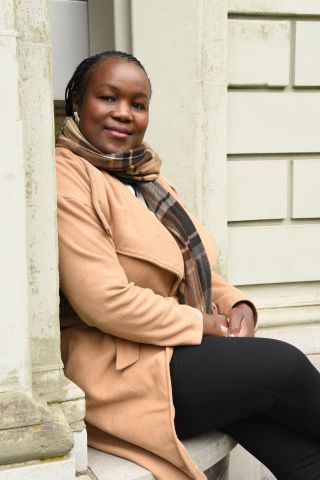
When Talent Nyandoro was growing up in Zimbabwe in the 1990s, a dramatic rise in HIV infections triggered a global health crisis. “Many people we knew died. And as a child I didn’t understand why,” recalls the research coordinator at SolidarMed Zimbabwe. She became interested in research early on as she was keen to understand what was going on around her and why people were dying of this disease. After her sociology degree, Talent initially worked in a bank. “But I was drawn back to healthcare,” she says with a smile. Because before she worked at the bank, she had completed a traineeship in a hospital where she was providing psychosocial support to patients including people with HIV and trauma survivors.
A better understanding
She has been working at SolidarMed for eight years, carrying out research to identify gaps in public healthcare. In sociological terms, Talent Nyandoro is interested in behavioural change, not in what can be treated with medication. “I’m happy at SolidarMed. I’ve completed further training in qualitative research methods, public health statistics and project planning, monitoring and evaluation,” she says, beaming. Qualitative methods focus on studying experiences, behaviours and the social settings of individuals through interviews and observation. By contrast, quantitative methods draw on numerical data to recognise patterns and relationships through statistical analyses.
Content Text
“Both approaches are essential in the field of public health, but I feel particularly drawn to qualitative research. It enables us to research social and contextual factors that have a major impact on health outcomes. Qualitative methods give us a better understanding of the challenges facing communities. This allows us to develop bespoke measures in the field of public health,” she says.
A wide range of research projects
Talent has already supervised a number of research projects for SolidarMed. In thematic terms they range from the feasibility and acceptance of HIV self-tests in young people at universities in rural Zimbabwe, to non-communicable diseases (e.g. school programmes promoting oral health), and mental health projects.
Content Text
Empowering youth: gender equity and addiction prevention
The PEGISUS project (Peer Education for Gender Inclusion and Substance Use in Southern Africa) aims to reduce alcohol and drug use in adolescents and young adults in Zambia, Zimbabwe and South Africa, while at the same time promoting gender equity.
Two evidence-based programmes (Manhood 2.0 and RAD-PAL) are being integrated in vocational training centres. Manhood 2.0 promotes healthy notions of masculinity, while RAD-PAL helps adolescents break risky consumption patterns and make healthy decisions. Integrating these programmes in vocational training reaches a particularly relevant target group. Talent Nyandoro brings valuable research skills to this research project in Zimbabwe. Initial results show positive changes with regard to attitudes to gender roles and drug use.
Content Text
Every project teaches her something. “You have to be flexible and versatile, particularly when conducting qualitative research,” she says. When Talent Nyandoro carries out field research, she does so without expectations: “Comparing reality with our own ideas is how we identify gaps in the system.”
Content Text
Some of the projects are implemented in multiple countries, such as the one on young people’s mental health (see above). This is where her expertise in project management comes into its own. She draws on both her extensive training and her broad experience when carrying out data analysis: “I’m so happy to be able to make a difference to the lives of the people we serve. I believe that our research can save lives and allow people to enjoy life for longer. Knowing that my work helps bring about such effective change inspires me every day to do more.”
Talent Nyandoro demonstrates the same passion and commitment in her free time when she goes running and trains for half-marathons. And her versatility is reflected in her hobbies and interests: she has a cooking channel on Instagram, but also likes to take it easy and enjoys reading.